

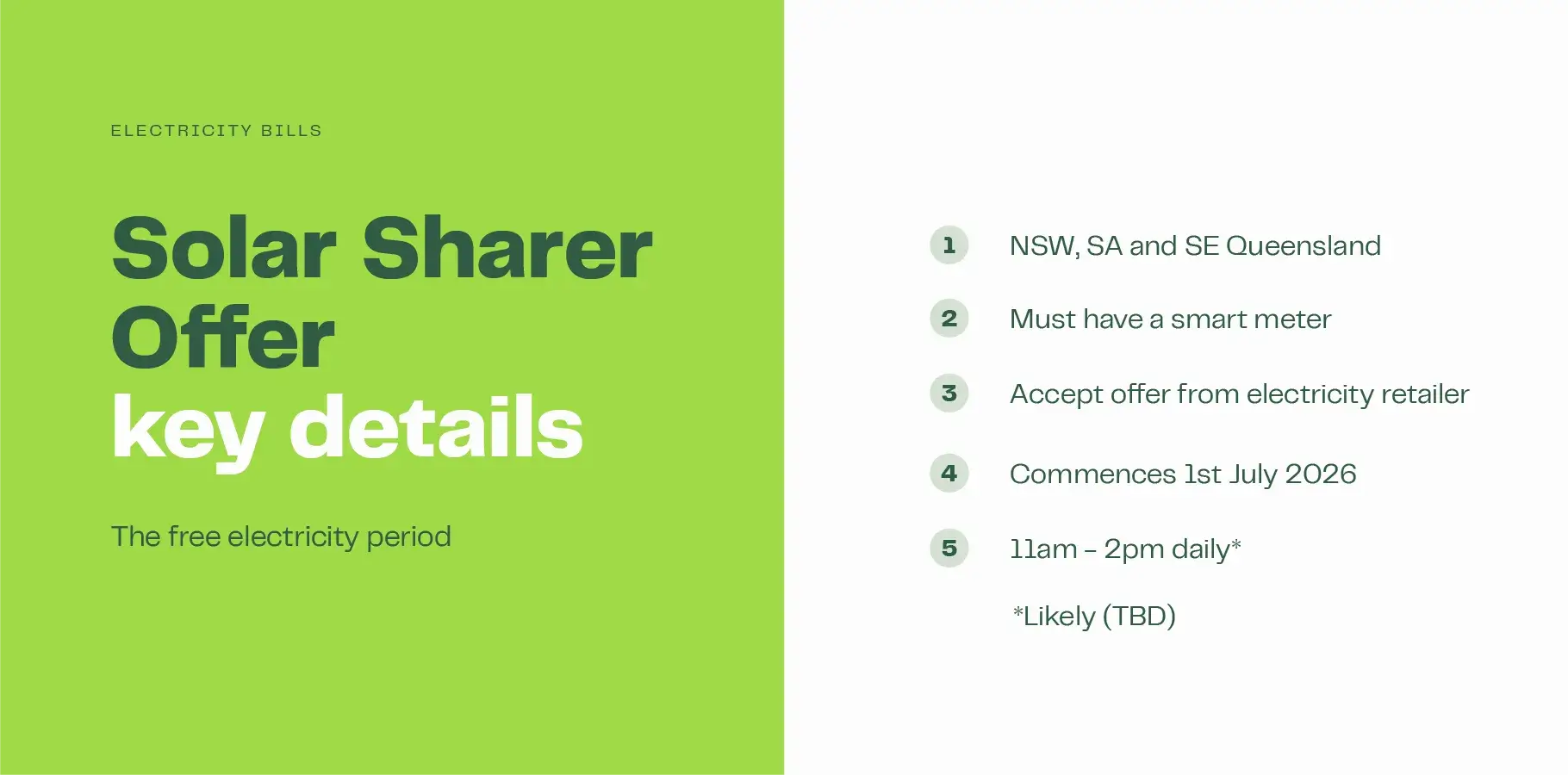
The proposed Solar Sharer Offer seeks to provide three hours of free electricity to eligible households from July 2026.
Australia’s strong solar uptake has created an abundance of renewable energy during the middle hours of the day when sunshine is at its peak. Just under 40% of Australian households now have solar panels. Typically, solar generates most electricity during the middle of the day, when electricity consumption is very low. As a result, wholesale electricity prices during this period of the day are also very low and sometimes even slip into negative territory.
The Solar Sharer Offer initiative proposes to shift consumption loads during these peak sunshine hours by providing households with free electricity. The initiative is especially good news for renters and households that do not own solar panels – as they will be able to benefit from the free electricity period.
What is the Solar Sharer Offer?
The Solar Sharer Offer is an initiative proposed by the Australian government whereby households from eligible states with a smart meter can access free electricity for a 3-hour window during the middle hours of the day.
The offer will be made available to domestic customers through their electricity retailer.

Who’s eligible
At this stage, the Solar Sharer Offer (SSO) is only available to residents in New South Wales, South Australia and south-east Queensland – as their electricity prices are subject to federal regulation. Residents of these states will need a smart meter to participate in the offer.
Victoria and Western Australia considering a similar offer
In reaction to the 3 hours of free electricity announcement, Victorian and Western Australian regulators are considering a similar form of offer. Both Victoria and WA regulate their electricity prices at a state level.
When does the Solar Sharer Offer start?
The Solar Sharer Offer is due to commence on 1st July 2026 for New South Wales, South Australia and south-east Queensland residents. If the Victorian and Western Australian governments follow suit and agree to a similar free electricity offer, it could take place as early as July 2027.
How the free electricity window will work
Any household, with a smart meter, will be able to access 3 hours of free electricity regardless of whether they have a home solar system or not. Households must opt in to a new electricity plan offer from their retailer to access the free power.
The 3 hours of free electricity is likely to run between 11am – 2pm each day, though hours will vary according to the offer put forward by electricity retailers.
Why is the Solar Sharer Offer being proposed?
The objective of the Solar Sharer Offer is to shift electricity demand from peak consumption hours to the middle hours of the day when solar systems generate more electricity. In theory, doing so will have several benefits, including:
- Reducing household electricity bills
- Lowering electricity prices
- Providing benefits for renters and those without solar
- Stabilisation of the grid by reducing peak demand periods
- Potentially avoid costly infrastructure upgrades
Excess solar generation
As solar installations in Australia increase, so too does the amount of excess solar energy that is exported back to the grid. In recent years, this abundance of solar generation during peak sunshine hours has put downward pressure on feed-in tariffs and seen the introduction of a ‘Sun Tax’ in some states.
The Solar Sharer Offer tackles the problem by rewarding consumers that can shift their electricity use to the middle hours of the day when solar generation is at its highest – thereby smoothing electricity consumption more evenly throughout the day.
Household benefits of the Solar Sharer scheme
For households, there are many benefits to the Solar Sharer Offer, particularly for homes that do not currently own solar panels.

Lower electricity bills
Households that can shift electricity loads to the free 3-hour period will benefit from lower electricity bills. Running appliances, or scheduling loads with smart devices to operate during the 3-hour window will lead to an increase in savings.
Lower electricity prices
In theory, the Solar Sharer Offer will decrease electricity prices by providing free electricity for 3 hours and reducing demand during peak hours. Shifting electricity use to the free period will reduce demand during peak hours, thereby placing downward pressure on electricity prices.
Renters benefit from solar
Renters that have been unable to install a solar system will benefit considerably from the Solar Sharer Offer. Just as using solar during peak daylight hours is the best way to make savings from a home solar system, the same principle will apply to renters. Rental households that can shift their electricity use to the 3-hour free period will benefit by not having to pay for electricity consumed during these hours.
EV owners can benefit
Electric vehicle owners can benefit from the 3 hours of free electricity offer by charging their vehicle during the free period. The average cost to charge an EV at home is around $21.27 in Australia. A 7kW home EV charger could potentially consume 21 kWh during the 3-hour free electricity period, potentially saving around $6.93 per day of charging (assuming 33c / kWh).
Charge your solar battery
For existing solar battery owners, one benefit of the proposed 3 hours of free electricity is the ability to charge a solar battery at no cost. Stored solar power could then be used to power household appliances during times of peak demand.
How to maximise savings from the Solar Sharer Offer
Savvy households that can shift their electricity loads can substantially benefit from the 3 hours of free electricity. The average household uses 15.31 kWh per day in Australia, the majority of it consumed during peak morning and afternoon / evening periods. Any kWh of electricity consumed during the 3-hour window will be free of charge.
For example, the cost of electricity in Sydney averages 36.7 per kWh. A household that can shift 5 kWh of electricity usage to the free 3-hour window could potentially save $1.83 per day. Over the course of a year, savings may equate to up to $670.
Savings will vary by household and location
Savings from the Solar Sharer Offer will vary by household and location. The average 2-person electricity bill in Brisbane is $563 per quarter, $218 lower than that for a 4-person household. It therefore stands to reason that households that have more occupants and use more electricity, can benefit more the offer.
Location is also a factor, the average electricity bill in Melbourne is unlikely to change until the offer is made available in Victoria.
Conclusion
The Solar Sharer Offer will benefit households that can shift their electricity load from peak periods to the new 3-hour electricity free period. Solar owners may not experience all of the benefits of the new offer, as they should already have changed habits in a bid to self-consume their solar generated electricity and therefore increase savings. Though, the SSO initiative can potentially increase savings for households that own a battery.
For households without solar, this is a chance to benefit from Australia’s abundance of solar generation during peak sunshine hours. It presents a legitimate opportunity to lower their electricity bills. When opting into the free electricity offer, households should be wary of the electricity rates of the new plan during peak demand times, as these may increase with the offer.
Source link