

Electric Vehicle (EV) sales in Australia surged between 2020 and 2025 thanks in no small part to generous federal and state level incentives on new car sales during this time. In 2025, EV sales accounted for 13.1% of all new car sales. In 2026, EV sales are projected to account for more than 15% of all new vehicles sold in Australia – a dramatic rise from the 0.78% market share they enjoyed in 2020.
In 2026, many of the generous early adopter grants and incentives for EV purchases have dried up. However, there are a number of applicable federal incentives, as well as state-based incentives that still remain. In this article, we publish the current federal and state-specific EV grants available in Australia.
Most of the EV rebates focus on providing an incentive at the point of purchase, charging the EV with a home solar system will deliver strong ongoing savings. Our solar panel calculator can provide savings results for new solar systems.
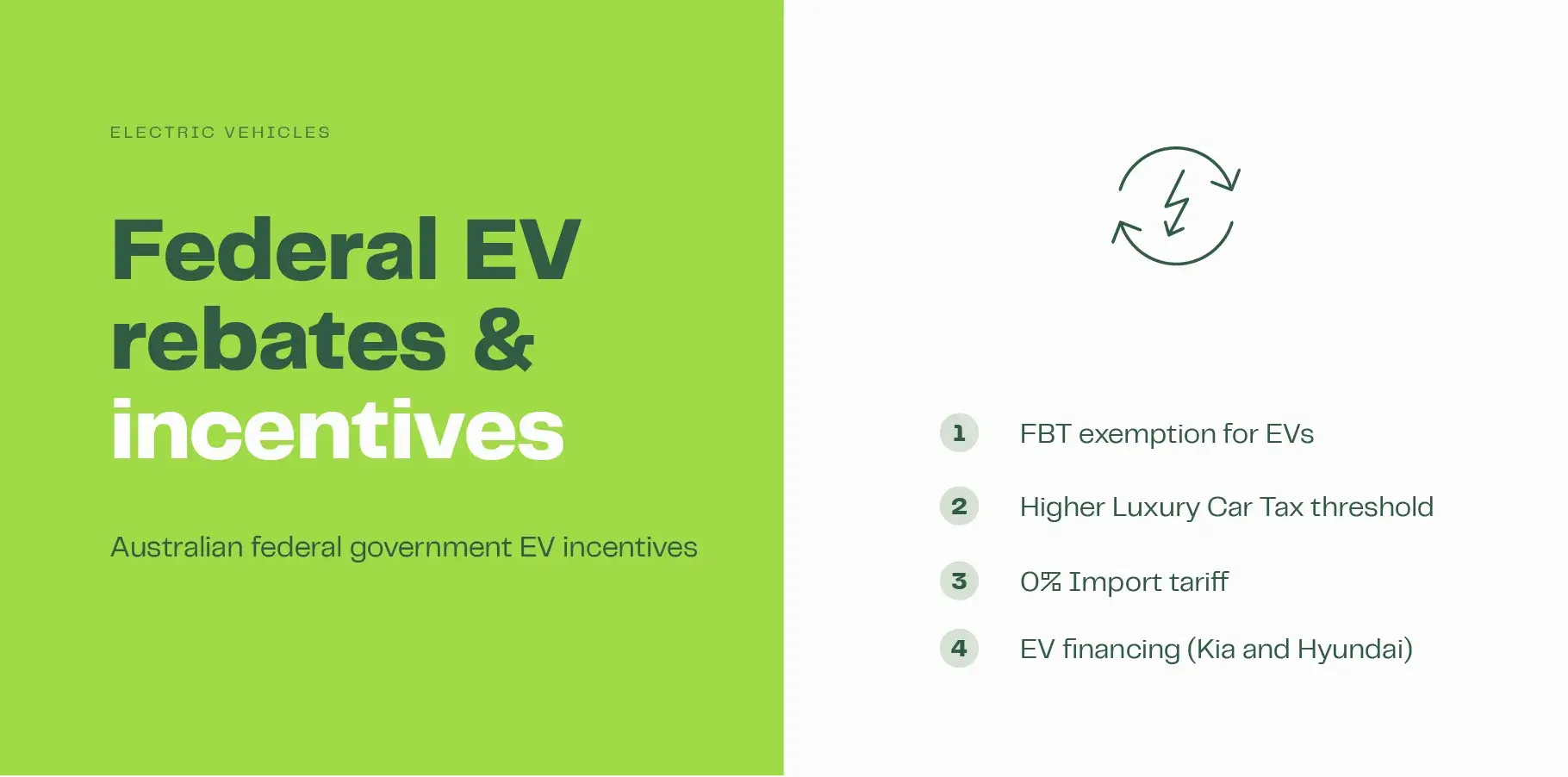
Federal EV rebates, grants, and incentives 2026

The following federal EV rebates and incentives are available in Australia in 2026.
Fringe Benefit Tax (FBT) exemption for EVs
The Fringe Benefit Tax (FBT) is the single biggest tax exemption currently available in Australia. The FBT exemption means that all EVs purchased through a novated lease or when purchased by an employer for an employee are exempt from Fringe Benefit Tax.
Fringe Benefit Tax savings are calculated based on individual income status. Australia’s Fringe Benefit Tax EV incentive is only available for completely electric vehicles that fall below the FY2025/26 Luxury Car Tax threshold of $91,387 for fuel efficient vehicles. Plug-in Hybrid Electric Vehicles (PHEVs) no longer meet the eligibility requirements for the FBT incentive on new novated leases following changes that were introduced on April 1, 2025.
Higher Luxury Car Tax threshold (LCT)
Fuel efficient vehicles including all EVs and PHEVs are subject to a higher Luxury Car Tax (LCT) Threshold compared to normal vehicles. The Luxury Car Tax Threshold for fuel efficient vehicles in FY2025/26 is $91,387 – compared to only $80,567 for petrol/diesel cars. The Luxury Car Tax threshold for EVs has left manufacturers playing a delicate pricing game over the last few years with Tesla, BYD, KIA, and many other EV manufacturers carefully pricing flagship “volume-selling” vehicles slightly under the threshold.
0% Import tariff on vehicles below the Luxury Car Tax threshold
EVs that fall under the LCT threshold of $91,387 for fuel efficient vehicles are not subject to the normal 5% import tariff. This tariff benefits manufacturers and has allowed them to deliver more competitive pricing to the end consumer.
Discounted EV financing (applies to Kia & Hyundai only)
The Federal Government has announced a new $60-million interest rate incentive package for Kia and Hyundai EVs. The Clean Energy Finance Corporation (CEFC) has committed $60 million to Hyundai Capital Australia (HCAU), allowing eligible buyers of Hyundai and Kia EVs to access finance rate discounts of 0.5% to 1.0% on loans for new vehicles priced at $91,387 or less (including GST), as well as demonstrator vehicles with under 5,000km on the odometer.
State & Territory EV rebates & incentives 2026

Australian Capital Territory (ACT) EV incentives
EV rebates and incentives for ACT residents have been slowly changing as many of the early-adopter incentives have been wound back in recent years. The ACT has moved away from total exemptions and now offers a series of partial discounts and incentives for those looking to purchase an electric vehicle.
The following incentives are currently available in the ACT:
- Lower registration on ZEVs – ~$382 per year (plus CTP and other levies)
- Lower stamp duty – 2.5% on all ZEV vehicles below the $80,000 threshold
- Access to low interest (3%) loans of $2,000 to $15,000 on applicable EVs
Emissions based registration incentives
The ACT ended its “2-year free registration” for all new Zero-emission vehicles (ZEVs) on the 30 June 2024 and transitioned towards a new emissions-based registration system which offers ZEVs the lowest cost for registration at ~$382 per year (plus CTP and other levies) – around 30-50% cheaper than a standard new petrol-powered vehicle.
Reduced stamp duty
The ACT government repealed its total stamp duty exemption for zero-emission vehicles (ZEVs), plug-in hybrids (PHEVs), and hybrids on September 1, 2025. Under new rules, these vehicles are now charged a minimum 2.5% stamp duty with vehicles worth over $80,000 being charged an extra 8% to the value above that threshold.
Sustainable Household Scheme loans
As of 2026, ACT residents can access low interest loans of $2,000 to $15,000 to purchase a new or used ZEV. The 0% interest rate was increased on July 1, 2025, and now stands at 3% – which is still well below market rates. The loans are only available on ZEVs that fall below the Luxury Car Tax (LCT) threshold of $91,387.
New South Wales (NSW) EV rebates
Generous state-level incentives in NSW, offered to early adopters between 2020 and 2023, played a major role in accelerating Australia’s EV market growth. Many of the generous upfront incentives including: the $3,000 upfront EV rebate, free registration, and total stamp duty exemption on new Electric Vehicles ended on December 31, 2023. Since then, the NSW government has focused on incentivising EV fleet adoption amongst private companies.
Current EV incentives in NSW include:
- EV fleet incentives of $5,000–$50,000 by vehicle type (funding exhausted; reopening Q2 2026)
- Lower registration costs for EVs and low-emission hybrids based on emissions
- Stamp duty exemptions for EVs are no longer active
- Free registration on all new and existing BEVs and PHEVs
- Stamp duty concessions on all BEVs and PHEVs below $50,000
- The NT’s EV charger grants have officially wound down and are no longer available
- Lower cost of registration – between 25-75% cheaper than comparable ICE vehicles
- Lower stamp duty of just 2% up to $100,000 for EVs
- All direct incentives for EVs in Victoria have now finished
- The Victorian Government’s Road User Charge (RUC) was overturned by the High Court in 2023, and EV drivers no longer need to pay per km travelled
- All direct incentives for EVs in Western Australia have now finished
- Unlike other states, WA does not offer any concessions for EV in their weight-based vehicle registration fees
- No incentives for new EV purchases
- 0% interest loans of up to $10,000 can be accessed through the Energy Saver Loan Scheme which can be used to cover the cost of an EV charger installation.
NSW EV Fleet Incentives
NSW kicked off generous EV fleet incentives ranging from $5,000 for cars to $50,000 for heavy commercial vehicles by category. The initiative also offers charging support of up to $3,000 per port for smart AC chargers installed. As of early 2026, the funding for this incentive is exhausted with the next round set to open in Q2 2026.
Lower Registration Cost
The NSW government discontinued free registration for EVs on December 31, 2023. Now, EVs and low-emission hybrids (under 150g/km CO2) are eligible for lower registration costs which are based on emissions rather than vehicle weight.
Stamp Duty
No stamp duty exemptions are active for EVs in NSW. The stamp duty exemption for electric vehicles (EVs) with a value below the luxury car tax (LCT) threshold ended on 31 December 2023.
Northern Territory (NT) electric vehicle incentives
The Northern Territory continues to offer some of the most generous EV incentives in Australia which include free registration on all new and PEVs, as well as generous stamp duty concessions. Unlike some states beginning to roll-out mileage-based charges for EV vehicles, the Northern Territory doesn’t have any such programs on the horizon.
Free registration
From 1 July 2022 until 30 June 2027, the Northern Territory offers free registration for all new and existing BEVs and PHEVs which includes vehicles that were previously registered, transferred from interstate, imported, and modified PEVs.
Stamp Duty Concessions
From 1 July 2022 until 30 June 2027 the Northern Territory offers stamp duty concessions of up to $1,500 for all BEVs and PHEVs valued at up to $50,000. Vehicles over the $50,000 will only pay 3% stamp duty on the portion that falls above the threshold.
EV Charger Grants
Concessions of up to $1,000 for residential and $2,500 for business EV charger installations concluded on the 31 December 2025.
Queensland (QLD) EV rebates
Like NSW, Queensland was behind Australia’s rapid EV adoption between 2020-2024 with generous upfront cash rebates of up to $6,000 on ZEVs. This scheme concluded on September 2, 2024, after $45 million in local funding was exhausted. While upfront incentives no longer apply, QLD continues to incentivise ZEV uptake with lower registration and stamp duty rates.
Lowest-tier registration
EV vehicle registration costs in QLD are charged at the same rate as 1,2-, and 3-cylinder vehicles – the lowest rate available. The $293.20 registration cost for EVs in QLD as of 2026 is between 25-70% cheaper than vehicles that fall into higher brackets.
Lower stamp duty
EV vehicles are charged just 2% per $100 (up to $100,000) stamp duty compared to 1-4 cylinder ($3 per $100), 5-6 cylinder ($3.50 per $100), and 7+ cylinder ($4 per $100). On an $80,000 EV purchase, this would equate to a saving of $800 – $1,600.
Victoria (VIC) EV incentives
As of 2026, Victoria has no remaining EV incentives and finds itself in the predicament of being arguably the “meanest” state for EV adopters. While the Victorian Government’s Road User Charge (RUC) was abolished in 2023 after being ruled unconstitutional by the high court, the only remaining direct benefit in the form of a $100 annual registration discount was officially closed on January 1, 2026.
Stamp Duty Concessions
EVs are exempt from Luxury Car Tax (LCT) and get a concessional rate of $8.40 per $200 of market value.
Western Australia (WA) EV discounts
The generous direct purchase rebate/incentive for new EV adopters in Western Australia officially wrapped up on May 10, 2025 which now leaves Western Australia in a similar predicament to Victoria with no incentives for new EV purchases.
ZEV Rebate Scheme (Ended)
The $3,500 rebate for new EVs purchased in Western Australia up to the value of $70,000 officially ended on May 10, 2025. This was the end of an era for one of the last remaining direct purchase incentives.
Registration Discount
None – Western Australia’s $100 discount for zero-emission vehicles ended as of January 1, 2026, which means that there are no current incentives or discounts for EVs.
South Australia (SA)
South Australia’s $3,000 EV subsidy closed on 31 December 2024, with no new applications accepted. The state’s 3-year registration exemption was also limited to vehicles first registered between 28 October 2021 and 30 June 2025. While some hangover remains on the 3-year registration exemption for vehicles that were purchased up to 30 June 2025, there are currently no new incentives being offered.
| EV incentive | Availability |
|---|---|
| Stamp duty concessions | None |
| Registration concessions | None |
Tasmania (TAS) EV incentives and rebates
Tasmania’s early adopter rebate of $2,000 for EVs was available to the first 375 applicable EV purchases ($750,000 total) and is now exhausted. The Stamp Duty waiver for new EV purchases has also concluded leaving no remaining rebates for EV purchases.
As of 2026, Tasmania has shifted towards “supporting” adoption through the Energy Saver Loan Scheme which offers interest free loans of up to $10,000 which can be used towards installing an EV charger at home as well as other energy efficient investments.
| EV incentive | Availability |
|---|---|
| Stamp duty concessions | None |
| Registration concessions | None |
In addition to the specific EV incentives, there are of course solar incentives available that will help to lower the cost of charging an EV. While rebates help trim the upfront purchase cost, charging an EV with solar panels is the best way to reduce the ongoing EV charging cost.
Source link