

Australia may be at the forefront of solar adoption, but when it comes to solar panel manufacturing, the story is a little different.
Over 38% of households have installed solar panels, yet of those over 4.2 Million households, only a tiny fraction have opted for panels that were actually made in Australia.
It is estimated that Australia imports 99% of all solar panels with 90% being sourced from companies in China. Many high-quality solar panels are manufactured in China where low labour costs, cheap materials, and economies of scale make it possible to produce panels at competitive prices.
For consumers only wanting Australian- made panels, there is only one option – Tindo Solar.
In this article we explain the benefits of local manufacturing, look at where solar panels are made and compare the virtues of local vs international manufacturing.
Tindo Solar: Australian-made solar panels
Tindo Solar is currently Australia’s only solar panel manufacturer.
Based in Adelaide, Tindo Solar was founded in 2011 by Adrian Ferraretto. Its name ‘Tindo’ means ‘sun’ in the local, indigenous Kaurna Warra language. The Kaurna people are traditional custodians of the Adelaide Plains region 1. The business manufactures and supplies high efficiency solar panels to homes and businesses across Australia.
Tindo has plans to increase its supply of panels to the Australian market. It recently received a $34.5 million grant under the Australian Government’s $1 billion Solar Sunshot Program. This funding will increase its Adelaide plant’s capacity from 20MW to 180MW per year and create 50 new local jobs.
Source: 1 Tindo Solar website
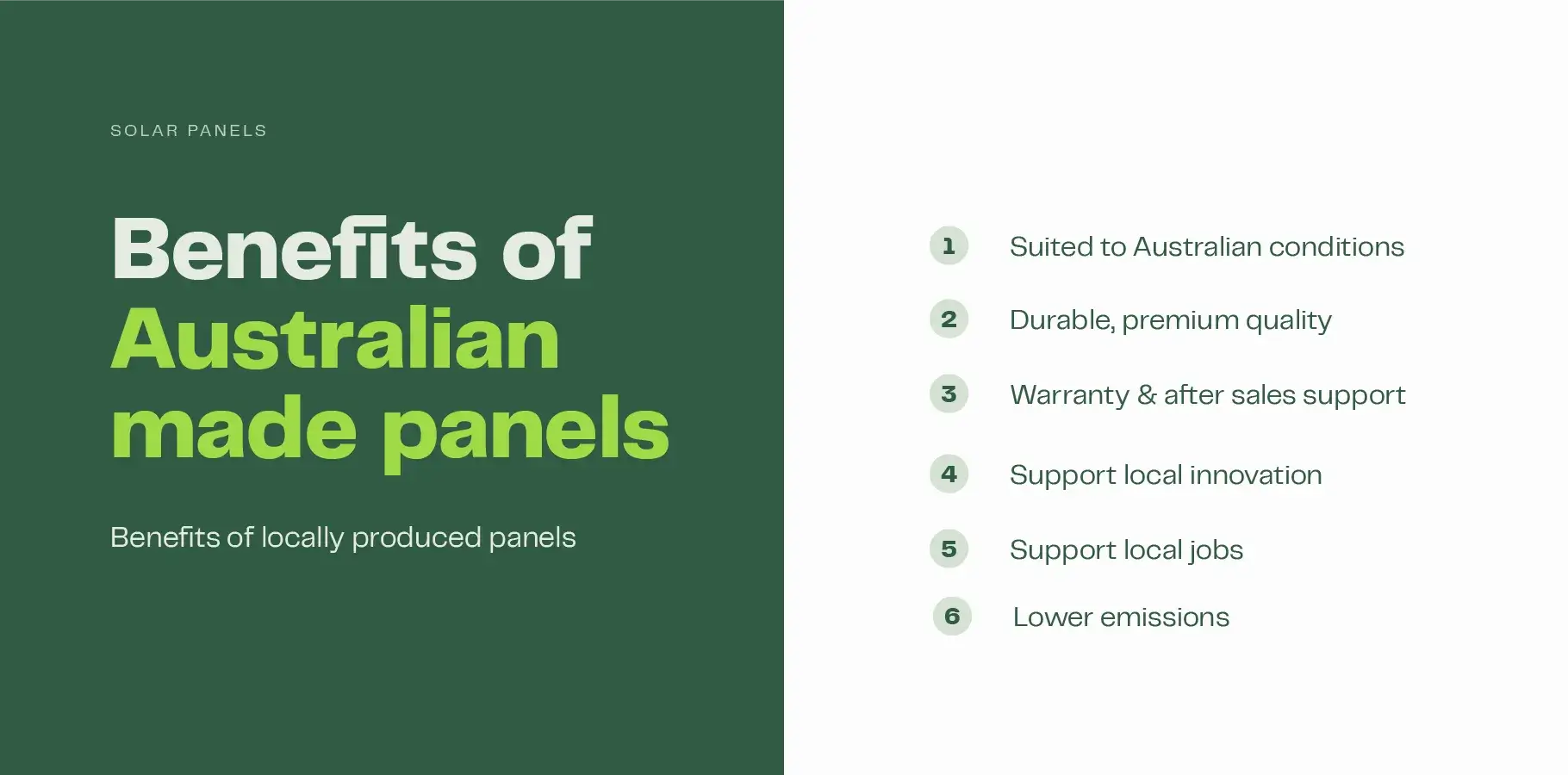
Benefits of Australian-made solar panels
Opting for Australian-made solar panels isn’t just an exercise in patriotism; there are solid reasons why Tindo has thrived in Australia’s price-sensitive solar market – despite the premium price tag. In addition to many benefits of installing solar panels, below are some additional reasons to choose to Australian-made panels.

1. Designed to suit Australian standards
Local production means an emphasis on creating a product that suits Australia’s unique climate. Tindo builds for a local market and considers real Australian conditions – think heat, high UV, salt, hail, and tropical weather – not just global averages.
Local manufacturing enables greater control over the process and strict quality, testing, and control standards – something that can sometimes slip through the cracks with entry-level panels.
2. Durable, premium quality
Beyond the usual IEC 61215/61730 box-ticks, Tindo products are manufactured and tested with local conditions in mind, meaning they’re built to handle heat, storms and other environmental stresses that can push imported products to their limits. That combination is especially relevant for coastal and storm-prone areas around the country.
Tindo solar panels also have anti-PID/LID measures and solid temperature behaviour – both essential for Australia’s sweltering summer heat.
3. Warranty & after-sales support
For most would-be buyers, warranty and after-sales support are where Australian solar panels shine.
Tindo offers a 25-year product warranty and a 25-year linear performance warranty across its entire range of Australian-made solar panels.
Panels are guaranteed to stay defect-free under regular use, and power output won’t drop below 98% in year one or 87.4% after 25 years. If something fails, Tindo covers parts, labour, removal, transport and also covers the cost for re-installation (remote sites may pay extra). Warranty claims are handled locally in Australia.
4. Support local innovation
Buying Australian-made panels supports the local economy and helps sustain innovation in a sector dominated by imports. Tindo has secured government backing to scale production and invest in advanced manufacturing.
That support filters into local supply chains, creates skilled jobs in Adelaide, and ensures Australia retains a (small) foothold in developing solar technology rather than relying entirely on overseas production. As we’ve seen in other countries, changes to imports and tariffs can have a significant impact, so maintaining some semblance of local solar production is extremely important.
5. Support local jobs
Tindo’s recent AU$34.5 million grant will create 50 new skilled jobs as it expands its Adelaide factory and boosts local solar panel output.
More broadly, local solar production supports jobs on the factory floor and across supply chains – including frame makers, glass suppliers, installers, R&D, and transportation
6. Lower emissions
There are two ways that buying Australian-made Tindo panels lower carbon emissions: 1. Freight emissions are lower as transport routes are smaller and, 2. Tindo makes use renewable energy to create their panels.
Where solar panels are made
Solar panels are primarily made of silicon, glass and metal. They are produced all over the world but manufacturing in some countries are far more prolific. China produces 84.6%2 of all solar modules worldwide and dominates the solar manufacturing market. Vietnam 3.4% of all panels worldwide while India is the third biggest producer at 2.7%.
The table below shows where solar panels are made:
| Country | % of Panel production worldwide |
|---|---|
| China | 84.6% |
| Vietnam | 3.4% |
| India | 2.7% |
| Thailand | 2.3% |
| United States | 2.2% |
| Malaysia | 2.1% |
| Other nations | 2.6% |
Source: 2 Worldwide solar panel production by country
Breaking down the quality perception
The perception that panels manufactured in China are poor quality, is simply a myth. Many of the best solar panel brands have their modules manufactured in China. High-profile companies like SunPower, have offices in other countries, yet still make their panels in China.

Is it worth choosing Australian-made solar panels?
While there are some benefits, and a level of patriotic pride, choosing Australian-made solar panels over other brands is neither here nor there when it comes to performance. Any solar installation will cut electricity bills and add value to your home.
Tindo produce really good quality panels that are suitable for Australian households. So do many other brands. When selecting a panel, it’s recommended you consider:
- Performance
- Efficiency
- Product warranty
- Value
Whether you decide to go with Australian-made panels or not, is very much a personal decision.
Source link