

Installing a household solar system can be a difficult and complex task. Understanding how systems work, deciding the type and size of system to install, and knowing which companies you can trust – are all important steps that must be overcome before installing solar panels.
Further confusing the decision-making process are terms like “free” and “cheap” solar. These solar advertising terms are used by some solar companies and can often mask low-quality products or questionable financial agreements.
It’s important for consumers to understand the full story and terms that are often tied to this kind of advertising for solar products.
Free, cheap, or however else you want to package it – if the deal seems too good to be true, then it most likely probably is.
Debunking cheap & free solar myths
Let’s debunk the common myth of “free” solar and look at the tipping point between good value and potential liability when you’re investing in solar.
Is free solar even a thing?

No.
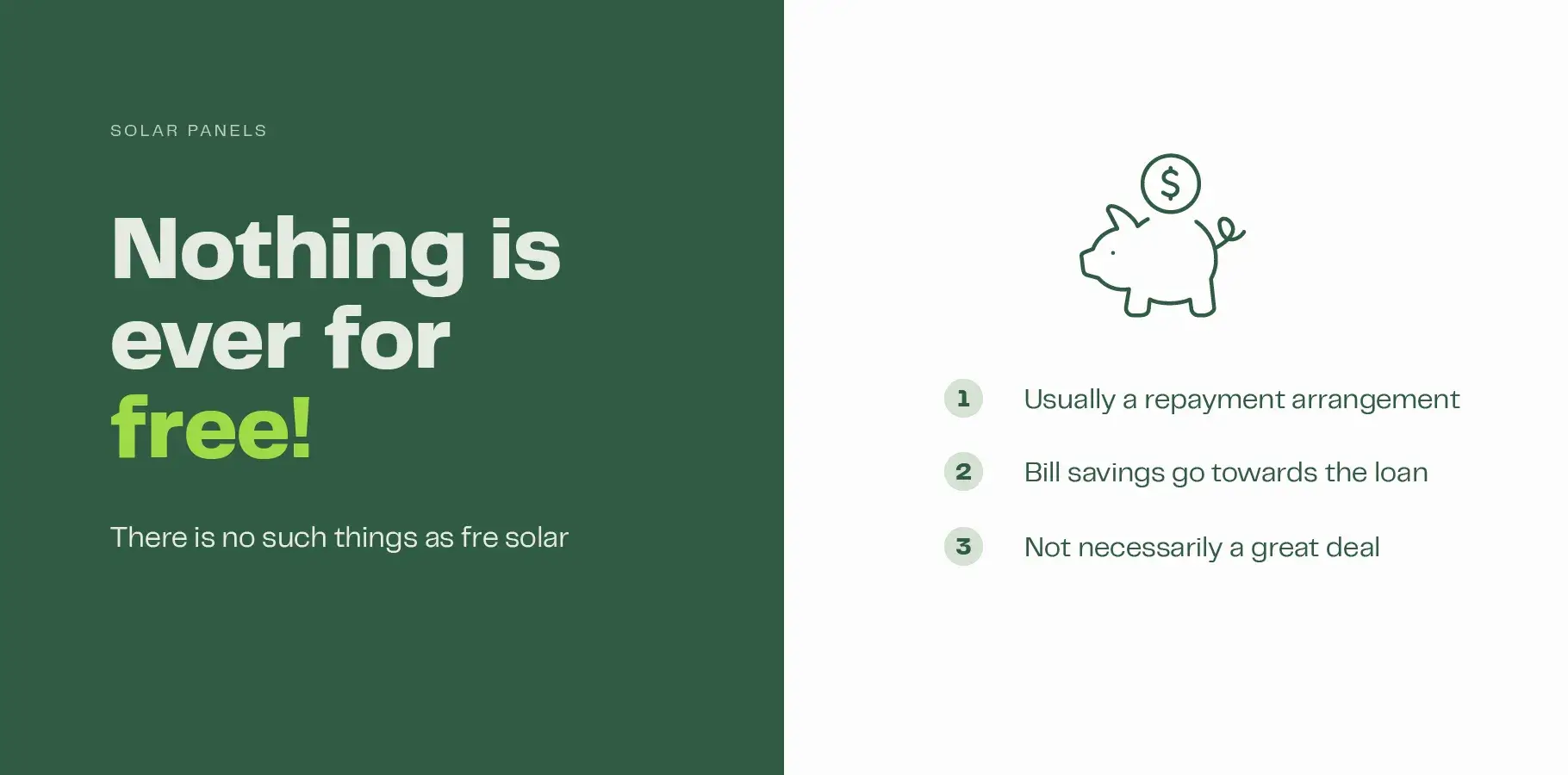
Free solar, even in the form of rebates from the federal government, is never “free”. Purchasing solar may entitle you to some cash back on your solar investment, but there are no such things as “free solar panels” – no matter how advertisers may package it.
Advertisers pushing “free” solar are typically pushing some sort of delayed payment system e.g. buy now pay later (BNPL) or a deal they have reached with a finance company to offer 100% finance on solar purchases. Savings from the new solar panels can go towards covering the repayments, but the system is definitely not free.
Of course, taking out a loan to purchase solar is not necessarily a bad idea –financing can be a good way to manage repayments throughout the payback period of the system.
That said, consumers should always be aware of their repayment obligations and any applicable fees before committing to a loan. Loans offered through a solar installer should be scrutinised against market rates to ensure you are getting a fair deal.
At best, advertisements for “free” solar are misleading. At worst, they may be construed as an attempt to mislead consumers into purchasing solar packages that they may not be able to afford.
How cheap is too cheap for solar?
It’s a valid question.
We all want to get a good deal when we invest in solar.
The fact is, there is no shortage of advertisers pushing very cheap solar packages. The kinds of deals that leave us scratching our heads wondering, “how on earth do they turn a profit on this stuff?”.
But what’s the tipping point between “cheap” solar and solar that is going to become a liability that doesn’t live up to advertisers claims for performance and potential household savings.
There is no tipping point when a system suddenly becomes too cheap – it will depend on your system requirements and location. We recommend using our solar calculator to determine rough pricing and using this as a benchmark to realistic cost expectations.
Common flaws in cheap solar products
- Reduced efficiency and output
- Low quality materials used in manufacturing
- Product defects that compromise performance and safety
- Premature degradation and rapid efficiency loss
- Limited, compromised warranty
- Improper or unsafe installation
What to look out for with misleading solar ads

Consumers should approach all solar promotions with a healthy level of scepticism. When comparing solar deals, common sense always prevails. Here are some of the most common solar advertising tactics to be aware of when considering cut-price solar.
Advertised prices that include government rebates or incentives
It is not against the law for solar companies to advertise prices that include rebates.
In Australia, the federal “rebate” for solar panels under the Small‑scale Renewable Energy Scheme (SRES) is applied by the installer as an upfront discount to the system price. The scheme works via Small‑scale Technology Certificates (STCs) which installers assign and sell to reduce the upfront cost to consumers.
Solar companies must make it clear in their advertising that the displayed price already includes the value of the rebate so as not to mislead the consumers.
Promotions using ‘solar postcode eligibility’
Any promotions that use “solar postcode eligibility” should raise red flags for consumers.
Whether you’re looking at solar panels or batteries, ‘postcode eligibility’ has never been a thing. Commissioner for Consumer Protection Owen Kelly recently warned consumers against this very sales tactic, reminding consumers that: “This is not a real criterion, and any ads requesting your postal address could be an attempt to collect your personal information,” in light of reminders issued to solar businesses regarding battery rebates.
Cold calls & door-to-door solar sales
Any cold call or unsolicited communication that you receive should be met with a healthy level of scepticism.
Complaints relating to unsolicited solar sales have been subject to a recent “designated complaint” made to the Australian Competition and Consumer Commission (ACCC) which specifically targets “the nationwide scourge of door-knock unsolicited selling.”
The Consumer Action Law Centre, joined by CHOICE and the Council of Small Business Organisations Australia (COSBOA), lodged this complaint in July 2024. Consumer Action CEO Stephanie Tonkin explained that these sales often occur “out of sight, most often in regional areas, and highlighted that “unsolicited door-to-door selling and telemarketing of many items, most notably solar panels”.
Consumers should be aware of unsolicited solar sales and understand their rights to refuse door-to-door and telemarketing sales.
False deadlines on rebates
Consumers should always be sceptical or solar companies that create false urgency through sales rhetoric.
The major government solar rebates, like the federal Small-Scale Technology Certificates (STC) scheme and Cheaper Home Batteries Program, decrease gradually over many years but they will not suddenly end overnight.
Final thoughts
Installing solar panels for your home is a long-term investment that can reap benefits for over 25 years. Buying quality will serve you well in the long term. When it comes to cut-price solar, common-sense should prevail: if it seems too good to be true, it probably is.
There are complexities that affect the cost of solar panels and they can vary from household to household. However, if you see advertised prices for cheap solar panels that are far below the guides we provide on this site, you should beware.
Stick to systems from established, trustworthy retailers and take the guesswork and the risk out of going solar.
Source link