

Electric Vehicles (EVs) have come a long way over the last five-years. Between 2020 and 2025, Electric Vehicles (EVs) evolved from a niche segment that accounted for less than 1% of all sales, to the fastest growing category for new vehicle sales in Australia with just over 13% market share. Many EV incentives are still available in Australia to help boost sales ratios even more.
Improvements in average driving range, along with the ongoing (albeit still limited) expansion of Australia’s EV charging infrastructure, have gone a long way toward easing the range anxiety that has plagued EV ownership.
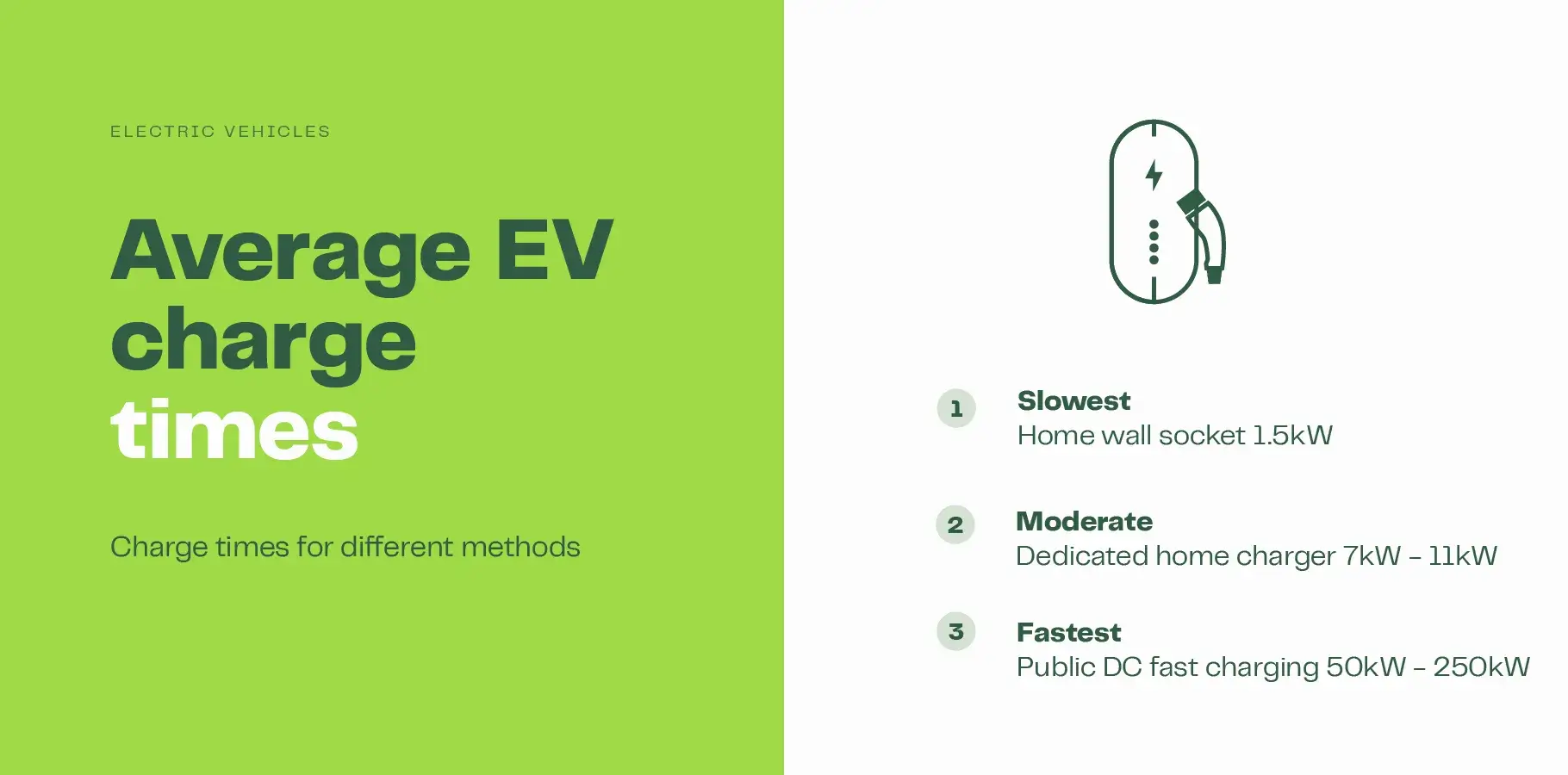
Average EV charge times 2026

When we consider the “average” EV charge times, it’s important to preface that charge times are contingent on two very important factors – your vehicle, and your charging method.
Naturally, EVs with larger batteries will take longer to charge than a vehicle with a smaller battery – no real surprises there.
Similarly, how and where you decide to charge your EV will have a dramatic impact on how long it takes to charge an EV in Australia.
When it comes to charging, there are three main options – a regular household socket, a dedicated home or public EV charger, or public fast-charging stations.
Slowest method – wall socket charger
Charging from a wall socket is the cheapest and easiest way to charge your EV at home. The trade-off? It’s slow! If you’re not driving huge distances and you’re going back to base regularly – whether that’s home or work – a wall socket charger might be a workable option.
Pros
- Cheap – most EVs come with everything you need to charge from a socket
- Easy to setup – just plug into a regular household socket and you’re good to go
- Convenient – if you’ve got a garage or space at work with close proximity to a socket (always ask permission), then you’re ready to charge
- Make use of solar power that is generated and/or stored at home
Cons
- It’s slow – charging from 0%-100% can take >2-days from a conventional 10A 220V wall socket
- It can place a strain on your household power supply – particularly in older buildings
Average EV charge times when using a wall socket charger
| EV model | Battery size | Charge time (approx.) |
|---|---|---|
| Tesla Model Y (Premium RWD) | 60 kWh | ~30 Hours |
| BYD Sealion 7 Premium | 82.56 kWh | ~41 Hours |
| Tesla Model 3 (Premium RWD) | 60 kWh | ~30 Hours |
| Kia EV5 Air Standard Range | 64.2 kWh | ~32 Hours |
| BYD Atto 3 Essential | 49.92 kWh | ~25 Hours |
| MG 4 Excite 51 (51kWh RWD) | 51 kWh | ~26 Hours |
Cost & time balanced method – dedicated EV charger
A dedicated EV home charger delivers a good balance between charging cost and time efficiency. A single phase (7kW) or three phase (11kW) home charger is ideal for delivering faster charging speeds without resorting to public DC chargers which can cause faster battery wear.
Pros
- Low cost of installation
- Good mix of time and cost efficiency
- AC charging is good for the battery
- Most EVs can be charged to full capacity overnight
- Make use of solar power that is generated and/or stored at home
Cons
- Some electrician/installation costs associated with initial setup
- Some costs associated with purchasing the hardware
- Slower than fast charging which is not ideal on short turnaround long trips
Solar EV charging can significantly reduce the ongoing cost of powering dedicated home chargers.
Average EV charge times when using an 11kW charger
| EV model | Battery size | Charge time (approx.) |
|---|---|---|
| Tesla Model Y (Premium RWD) | 60 kWh | ~5.5 Hours |
| BYD Sealion 7 Premium | 82.56 kWh | ~7.5 Hours |
| Tesla Model 3 (Premium RWD) | 60 kWh | ~5.5 Hours |
| Kia EV5 Air Standard Range | 64.2 kWh | ~6 Hours |
| BYD Atto 3 Essential | 49.92 kWh | ~7.5 Hours (Capped 7 kW Charge Rate) |
| MG 4 Excite 51 (51kWh RWD) | 51 kWh | ~8 Hours (Capped 6.6 kW Charge Rate) |
The three phase 11kW chargers reduce charge times. It takes around 5.5 hours to fully charge a Tesla 3 at home using a three-phase charger using a three-phase charger.
Fastest method – public fast charge stations
Public fast charging stations – including Tesla’s Supercharger network – are the fastest way to charge an Electric Vehicle. For quick top-ups or road trips, fast charge stations are the best options. However, there are a few drawbacks which are worth mentioning – namely price, limited network, and added battery strain.
Pros
- They are fast – like really fast. At their fastest, a 250kW DC charger can charge a typical EV battery from 0-80% in less than 20-minutes
- Ideal for road trips or occasional top-ups when short on time
- Even at their most expensive, fast chargers are still comparable to the cost of filling an ICE vehicle
Cons
- Fast charging is expensive – around 50% more than normal public AC chargers
- Limited network – even though the number of fast charging stations is growing, it is still a long way from being a “practical” solution
- DC charging can cause premature battery wear. High power delivery generates
- Additional heat in the battery pack which wears the battery and, over time, impacts range
Average EV charge times when using a fast charger
| EV model | Battery size | Peak DC rate | Charge time (approx.) |
|---|---|---|---|
| Tesla Model Y (Premium RWD) | 60 kWh | 170 kW | ~25–30 min |
| BYD Sealion 7 Premium | 82.56 kWh | 150 kW | ~32 min |
| Tesla Model 3 (Premium RWD) | 60 kWh | 170 kW | ~25–30 min |
| Kia EV5 Air Standard Range | 64.2 kWh | 141 kW | ~36 min |
| BYD Atto 3 Essential | 49.92 kWh | 70 kW | ~45 min |
| MG 4 Excite 51 (51kWh RWD) | 51 kWh | 88 kW | ~37 min |
Public fast charging and the Tesla advantage
It would be remiss not to mention the significant advantage enjoyed by Tesla owners when it comes to fast charging in Australia.
Tesla has faced its fair share of scrutiny over the last few years. Fair to say that much of that has been self-inflicted, however, if there’s one thing that the US manufacturer has always had working in their favour it is their Supercharger Network.

As of early 2026, Tesla has 130 Supercharger sites with 800+ individual chargers in Australia. And while Tesla continues to lead the way when it comes to brand-led EV charging infrastructure in Australia, it’s hard to ignore just how far we are from the 2,500+ Tesla Superchargers across the USA.
Comparisons aside, Tesla is still miles ahead of the competition when it comes to their Supercharger network.
Now, as Tesla seemingly bows to the relentless influx of Chinese and South Korean EVs entering the Australia market, the US manufacturer has opened up 66% 1 of their Supercharger network to (86 sites with 564 posts) to non-Tesla vehicles.
The move is welcome news for the broader EV community looking for on-the-go fast charging. That said, don’t for a second think that the move isn’t grounded in commercial interests. The cost to charge a Tesla using a fast charger ranges between $40 – $52.50 while non-tesla vehicles paying almost 40% more than their Tesla-driving EV counterparts when charging at these locations.
Source:
1 Tesla Supercharger sites open to other EVs
Final verdict – How long does it take to charge an EV?
So then, how long does it actually take to charge an Electric Vehicle in Australia?
The answer – it depends.
At the slowest end of the scale for the vehicles included in this test, the BYD Sealion 7 Premium with its enormous 82.56 kWh battery would take 41 hours to charge from 0-100% using a standard 10A wall socket delivering roughly 2kW.
At the fastest end of the scale, the Tesla Model 3 and Model Y with their ~60 kWh batteries and uncapped charging efficiency can charge from 10-80% in as little as 25-minutes using a DC fast charger.
The best solution? It probably lies somewhere in between these two extreme ends of the scale. An 11kW AC home charger that uses three phase power is capable of charging all of the most popular EV models overnight (5.5 – 8 hours).
Source link