

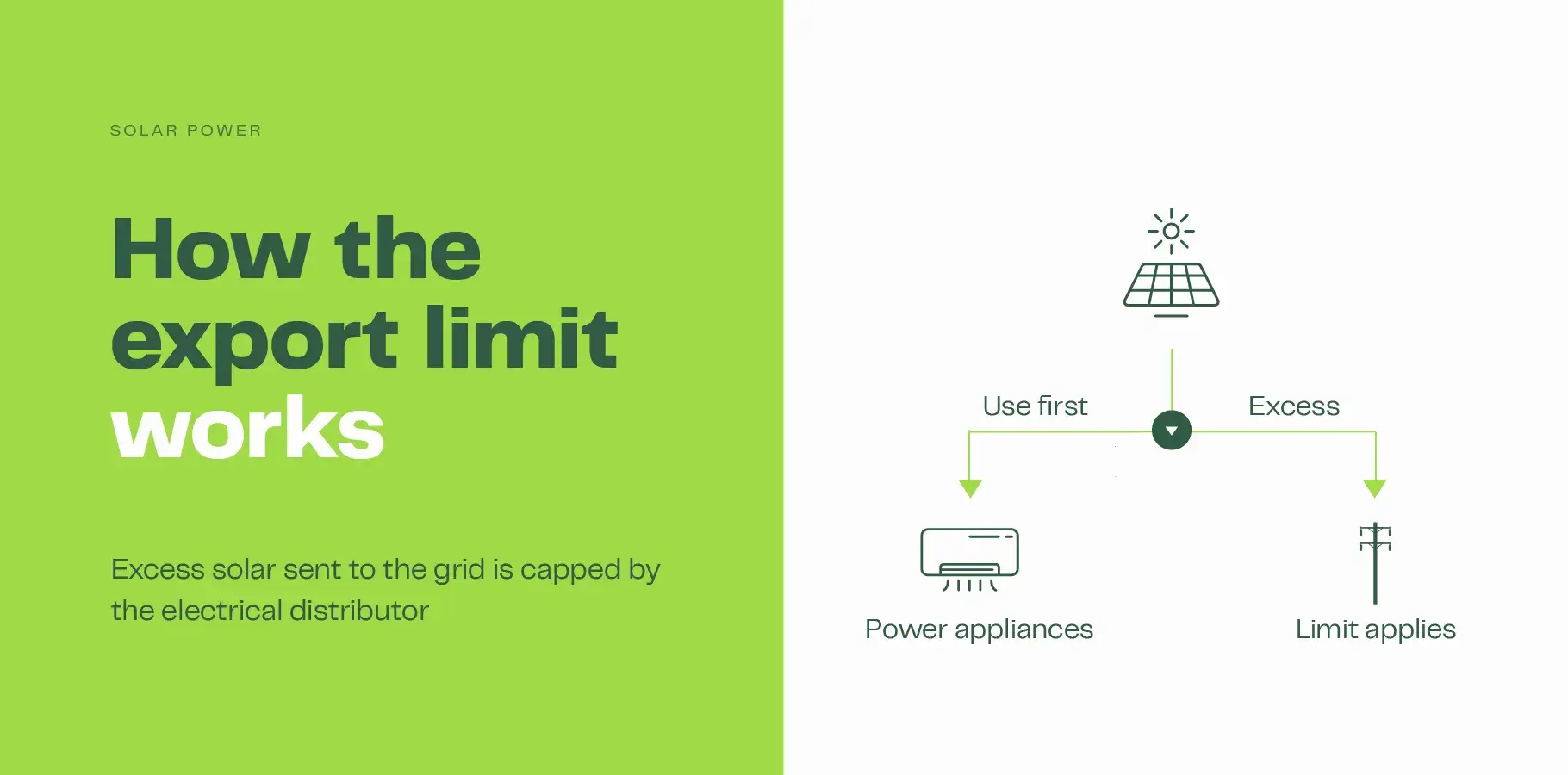
Solar export limits are a restrictive measure placed on systems to control the amount of renewable energy sent back to the grid. Without these throttling devices, the excess energy generated by solar panels has the potential to destabilise the electricity grid.
However, while they may seem like a limiting device, in truth they have little impact on how many panels you can install. And, if you plan to install a battery with your system, then chances are you can install the system size of your choice.
Export limits vary by state and electricity distributor. In this article, we publish the limits in your local area and explain how your home solar system may be impacted.
How the solar export limit works
Limiting solar exports is only likely to impact system savings slightly. There are no limits on how much electricity you can generate, only limits on what you can export to the grid. We explain how solar export limits work.

How solar systems are set up to work
A typical solar panel system works by powering your household electrical appliances before sending energy back to the grid. There are no restrictions and you can use as much electricity as you generate.
For battery systems, household appliances are powered first, batteries are charged next, then any excess solar energy generated is sent to the grid through the distributor.
Any excess electricity sent to the grid below the export limit will attract a feed-in tariff – a financial credit that lowers your electricity bill.
Electricity distributor sets the export limit
The solar export limit is set by the Distribution Network Service Provider (DNSP) for your location. Network providers are responsible for managing the poles, wires and all of the associated infrastructure in your area – they are separate to your electricity retailer.
The DNSP sets an export limit for each electrical connection to your house, typically between 5kW – 10kW (per phase). Limits are enforced by hardware that throttles inverter output once export limits are reached.
Solar export limit for 3 phase power
Export limits apply to each phase, so if you have 3 phase power, you can effectively export three times as much electricity to the grid before the export limit is reached.
What happens once the export limit is reached?
If the export limit is reached, the limiting device throttles down the inverter and the electricity goes to waste. Typically, this happens during peak sunshine hours during the middle hours of the day when solar generation is high, but household electricity consumption is low.
A 10kW system won’t produce 10kW of power
Solar panels can be oversized in relation to their inverter, because the panels never operate at their full capacity due to a number of limiting factors. So, a 10kW system, even at peak performance, may only generate 75% of its allotted capacity. Performance limitations include:
- Dirt and grime
- High temperatures
- Indirect angle of the sun
- Efficiency losses
These efficiency losses also explain why inverter sizes are typically smaller than the system size.
Why limits are needed
Nearly 39% of all Australian homes have solar panels, the figure is above 50% in South Australia and Queensland. Solar export limits are needed to stabilise the energy flow through to the grid created by all of the renewable energy systems. Excess generation can cause instability leading to blackouts and power surges.
Export limits by state and distributor
The table below shows the current solar export limits by state and electricity distributor:
| State | Distributor | Export limit | 3 Phase limit | Notes |
|---|---|---|---|---|
| VIC | Citipower | 5kW | 15kW | Flexible limit trial to commence 2026 |
| VIC | Powercor | 5kW | 15kW | Flexible limit trial to commence 2026 |
| VIC | Jemena Energy | 5kW | 15kW | *Inverter capacity 10kW |
| VIC | AusNet Services | 5kW | 15kW | *Inverter capacity 10kW |
| VIC | United Energy | 5kW | 15kW | *Inverter capacity 10kW |
VIC solar export limit
Five electricity distributors service the state of Victoria. Each of Citipower, Jemena Energy, Powercor, AusNet Services and United Energy has the same solar export limit of 5kW per phase. However, inverters up to 10kW can be installed on each phase.
| State | Distributor | Export limit | 3 Phase limit | Notes |
|---|---|---|---|---|
| NSW | Essential Energy | 5kW | 15kW | Flexible limit is 10kW |
| NSW | Endeavour Energy | 5kW | 15kW | Flexible limit is 10kW |
| NSW | Ausgrid | 10kW | 30kW |
NSW solar export limit
The export limit for solar in NSW ranges between 5 – 10kW per phase. Customers that belong to the Endeavour Energy and Essential Energy networks, have a fixed export limit of 5kW per phase. A new flexible limit is being introduced which will allow customers to export a maximum of 10kW per phase, if the network has the capacity to handle the export.
Ausgrid solar export
Ausgrid network customers have a higher 10kW limit per phase. Households that have a system with a 3 phase solar inverter can export up to 30kW across the three phases.
| State | Distributor | Export limit | 3 Phase limit | Notes |
|---|---|---|---|---|
| QLD | Ergon | 5kW | 15kW | Dynamic connection limit 10kW |
| QLD | Energex | 5kW | 15kW | Dynamic connection limit 10kW |
QLD solar export limit
Solar export limits in Queensland range between 5kW to 10kW per phase. The fixed export limit with both Ergon and Energex is 5kW per phase, so a household with 3 phase connection can export 15kW.
Customers that opt for dynamic exports have a higher 10kW limit, though it depends on network capacity.
| State | Distributor | Export limit | 3 Phase limit | Notes |
|---|---|---|---|---|
| SA | SA Power Networks | 1.5kW | Flexible limit up to 10kW |
Solar export limit for South Australia
SA Power Networks, the main distributor in South Australia has a 1.5kW export limit per phase. However, they are introducing a flexible limit that will allow for up to 10kW to be exported if the network has capacity.
| State | Distributor | Export limit | 3 Phase limit | Notes |
|---|---|---|---|---|
| TAS | TasNetworks | 10kW | 30kW |
Tasmania
The Tasmanian Economic Regulator sets the feed-in tariff in the Apple Isle. From July 1 2025, the feed-in rate is 8.782c / kWh, down marginally from the previous year.
The rate is reviewed annually.
| State | Distributor | Export limit | 3 Phase limit | Notes |
|---|---|---|---|---|
| ACT | Evoenergy | 5kW | 10kW |
Australian Capital Territory
Feed-in tariffs in Canberra vary with each electricity retailer. Rates are typically between 5.0c – 10c per kWh.
Minimising the impacts of export limits
There are several ways to mitigate against the impact of solar export limits.

1. Invest in a solar battery
A solar battery is the best way to store excess solar energy for use during off-peak (non-sunlight) hours. The average cost for a 10 kWh solar battery ranges between $8,000 – $10,000, with payback periods ranging from 6 to 10 years depending on your location.
Solar batteries are far more appealing than only one year ago. The federal government’s solar battery rebate kicked off on the 1st July 2025 with savings of up to $372 per kWh of battery storage. The rebate is set to continue through to 31st December 2030, however, the incentive will reduce each year between now and then.
2. Run appliances during peak production times
Any opportunity you have to run electrical appliances during the peak solar production times should be taken advantage of. Peak production hours are typically during the middles hours of the day and coincide with working hours. Using solar energy during peak production times is the best way to maximise savings.
3. Set appliances on a timer
Setting a timer on appliances is the best way to make the most of energy produced during peak hours if you are not at home. Time your appliances, such as your dishwasher, washing machine, dryer, pool filtration system, EV charger, and all other high-energy appliances, on an approved timer so they run between the hours of 10 am and 2 pm, when your solar panels are typically generating the most electricity.
4. Charge your electric vehicle (EV)
If you have an electric vehicle (EV), or plan to get one soon, charge it during daylight hours if you can. Using as much electricity, even if it is charging a battery, will further reduce the amount of energy you send back to the grid. LINK
Export limits need not deter you
While the idea of limiting the production of clean solar energy seems counterintuitive to Australia’s green energy push, export limits are a necessary measure. The electricity grid wasn’t designed to handle large volumes of solar power flowing in from homes back to the grid.
Export limits need not hinder your desired home solar system. With feed-in tariffs getting lower and lower, the financial impact imposed by the limits is minimal. With Australia’s continued push towards solar batteries and full household electrification, more and more solar energy will be used and stored before it is sent back to grid.
Source link